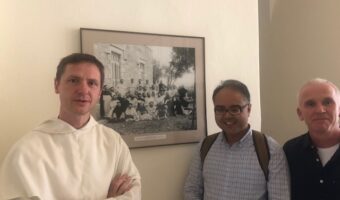
Fr. Olivier Catel, Already a PhD. in Literature, On Writing His PhD in Talmud at Hebrew University, Jerusalem

12 January 2023

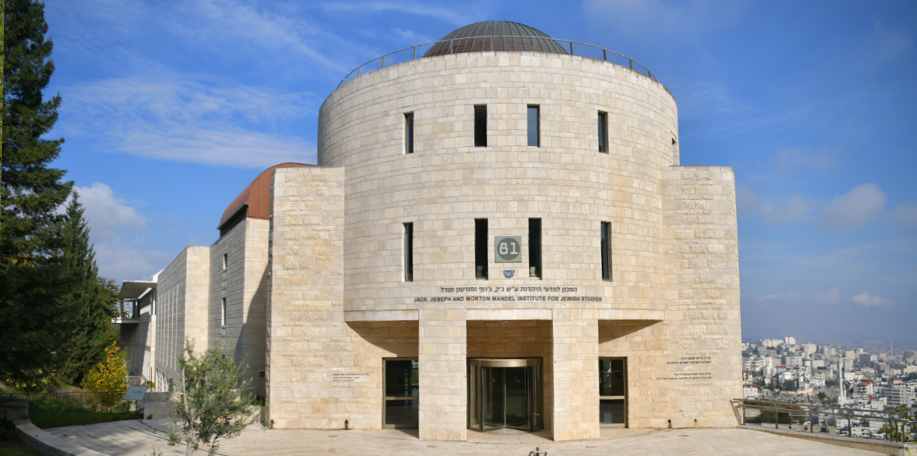
Mandel building, Institute of Jewish Studies, Hebrew University, Jerusalem, Israel

What is your current research?

O.C: I’m currently a doctoral student in Talmud at the Hebrew University and I am working on fasting in Christian and rabbinic literature of the 3rd century, trying to better define the internal dynamics of each tradition regarding public and private fasts. It is also an opportunity to study biblical and post-biblical traditions, to see how Scripture has been used over the centuries in Judaism and Christianity to justify the institution of ritual practices.

On what occasions have you used the database of The Bible in its Traditions?

O.C.: In the course of my research, I worked on the fasting of the Ninevites in the book of Jonah. So, I was happy to use our database. The great advantage of our portal, in contrast to the commentaries, is that we can have the raw material at our disposal, without any particular bias or orientation, and thus develop our own reading proposal, our own path. In addition to the extremely interesting notes on the text and the versions, I particularly appreciated the rich annotations in the “reception” section: beyond the text, the various commentaries of the Fathers of the Church allow us to grasp the primordial place that this text played not only in Christian thinking on penance and conversion but also in the polemic between Jews and Christians. Christians have often seen themselves as the Ninevites: salvation is open to the Gentiles while the Jews refuse to convert. The Jewish response was quick: it is not Christian asceticism that saves but repentance, which Israel knows how to practice in full.

How is this database different from the “great commentaries”?

O.C: This database is an essential complement to the great traditional biblical commentaries. The synthetical notes, which are becoming more and more numerous, also provide a broader and more global vision of the chief problems of biblical theology.

_

Our scroll presents the best results of our research in an innovative interface.
In this Beta version, It offers new translations of the main versions of the Scriptures, accompanied by rich multimedia content.

Access the scroll

_

This internet platform is a comprehensive tool for researching, studying and reading the Bible.

Access to the collaborative platform

_

Bibleart mobile application will offer a new French translation of the entire Bible enriched with thousands of multimedia contents, resulting from the work of our specialists.

Go to BibleArt

These articles may interest you

Digital development continues

Digital development continues

30 November 2019

Brothers Kevin Stephens (USA), Gad Barnéa (Israel) and Pierre Hennequart (Paris) meet by videoconference each week for a working session with fr. Olivier-Thomas Venard, to develop an application that will offer our new translation of the entire Bible, fully illustrated with images, sound and video, in the spirit of Prixm. In addition, Spyrit (Versailles) is […]
Upcoming publications

Upcoming publications

23 April 2019

The editorial committee, made up of our general assistant Dr Bieke Mahieu, Ffr. O.-Th. Venard, Jorge Vargas, Augustin Tavardon, under the direction of fr. Łukasz Popko and the efficient secretariat of fr. Marc Leroy, continues to work for about an hour and a half every Friday, to proofread, correct and enrich our forthcoming works printed […]
Three conferences on the Bible and its traditions

Three conferences on the Bible and its traditions

18 May 2023

Les pépites from the BEST on 10 May, by Sr Marie Reine Fournier: “Twelve women, one face” As part of the Bible In Its Traditions programme, each researcher opens his or her research laboratory to report on progress.Soeur Marie-Reine presented her work on analysing the portrait of the Virgin Mary through several major figures in […]