Presenting “The Word of THE LORD that Happened to Hosea” (Leuven: Peeters, 2017).

23 décembre 2017

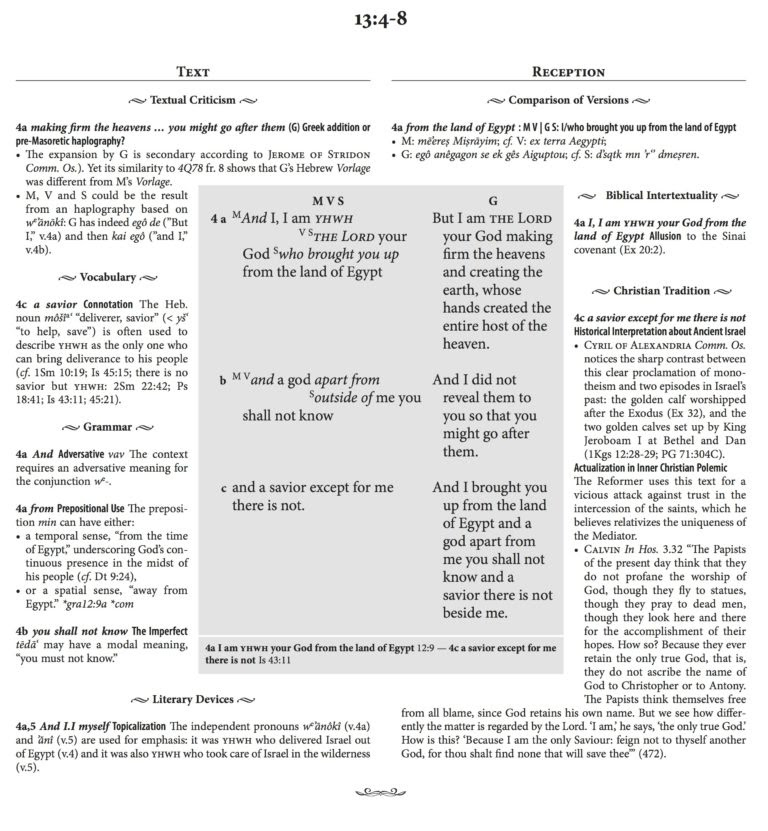
Une page de notre édition d’Osée

According to the Talmud, “Four prophets prophesied in one age and the greatest of all of them was Hosea.”

The book of Hosea is in fact a key to the Hebrew Bible, a unique witness to the ancientness of Scripture, as it offers a number of the oldest attestations of the one or other tradition, for example the Exodus, the Decalog as well as such patriarchal legends as the cycle of Jacob…

Theological Revolution

But Hosea is much more than a deposit of ancient traditions. Hosea’s prophecy harbors phrases that have transformed the image of God forever:

“Because of this, behold, it is I who will lead her astray and lead her down into a wilderness and speak to her heart.” (Hos 2:14)
“And I will betroth you to myself forever and I will betroth you to myself in righteousness and in justice and in kindness.” (Hos 2:19)
“My people perish for lack of the knowledge.” (Hos 4:6)
“He will revive us after two days; on the third day he will raise us up and we will live before his face.” (Hos 6:2)
“Out of Egypt I have called out to my son.” (Hos 11:1)
“My heart has turned against me, my consolations have been kindled I will not do the heat of ⇥my anger… For I myself am God and not man.” (Hos 11:8-9)
“For I desire kindness and not sacrifice, and knowledge of God rather than burnt offerings.” (Hos 6:6)
“Where [is] your judgment, Death? Where [is] your sting, Hades?” (Hos 13:14)

In compiling as best they could fourteen chapters of glowing poetry, the ancient prophet of more than twenty-eight centuries ago and those who transmitted him gathered words that are forever living. Complaints and threats by the lover who had been turned away, the groaning of the deceived and still smitten husband, the implacable indictment by the angry judge, the triumphant blast of the trumpet, the father’s tender encouragement of his children – far from the immobile first mover of Greek philosophy, this is literally the heart of a passionate God who pours out his feelings that are turned upside down with humanity in these inspired pages.

Collaborative Work

Eugen Pentiuc, who is now professor of Old Testament and Hebrew and Associate Dean of Academic Affairs for Hellenic College and Holy Cross in Brookline, MA, is a former student of the Ecole biblique et archéologique française de Jérusalem. He did us the favor of joining the research program from the time it was launched at the 2006 Catholic Biblical Association (Fordham University). As a specialist in Hosea, he had already published a commentary on this book in Romanian in 2001. The impulse given to our work by Eugen has brought to the present writing its clearly philological contour, perseverance in formulating historical hypotheses throughout Hosea’s ancient prophecies, and an emphasis on the present-day relevance of Hosea’s teaching about the true personality of God, whose intimacy with the human being went even to the incarnation (cf. his Jesus the Messiah in the Hebrew Bible, New York / Mahwah, N.J.: Paulist Press, 2006).

Three other translators and philologists — fr. Łukasz Popko op (of the Ecole), fr. Etienne Méténier beat., and Gad Barnéa — made it possible to perfect the translation by moving to notes all conjectures concerning the Hebrew text and by systematically adding the readings found in the various versions, while eight other scholars enriched it with the history of the book’s reception.

Our Editorial Committee had considerable work to do for almost nine months, with each person dedicating him- and herself for the revision and elaboration of notes in their field of competence: Jorge Vargas for the translation and philological annotation, Paul-Marie Chango for philosophy, Augustin Tavardon for Protestant readings, Olivier-Thomas Venard for the literary description, suggestions for reading and supervision of the history of the book’s reception. Five external collaborators brought us their expertise for annotating the prophet in Christian tradition, mysticism, the visual arts and Jewish tradition. A dozen of translators-editors also intervened in order to adapt the material that was written in French. Nothing would have been possible without the extraordinary

For the first time, the four great versions in which this Word has gone through the centuries – the Masoretic text, the Septuagint, the Vulgate and the Syriac version – have been collated and meticulously translated into English on the same page; this is accompanied by a wealth of annotations that allow one to hear the echoes throughout the various periods, the confessions and the disciplines, from textual criticism to films, passing by way of the Jewish and Christian traditions, literature, painting and music.
Who is wise and will understand these — intelligent and will know these?” (Hos 14:9).

_

Sur le « scroll », retrouvez la Bible dans une interface qui concentre l’histoire de la transmission des Écritures, depuis le rouleau antique jusqu’à la base de données d’aujourd’hui.

Accéder au scroll

_

Sur cette plateforme collaborative, biblistes et autres spécialistes créent la base de données qui alimente nos publications numériques et imprimées.

Accéder à la plateforme

_

En installant l’application Bibleart sur votre mobile ou votre tablette retrouvez toute la Bible en une heureuse rencontre de créativité contemporaine et de trente siècles de traditions.

Accéder à BibleArt

Ces articles peuvent vous intéresser

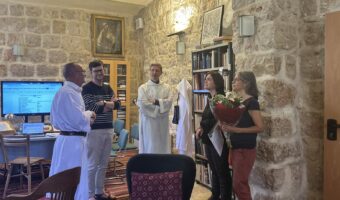
1. Dans nos bureaux, à Jérusalem

1. Dans nos bureaux, à Jérusalem

24 juin 2026

Le comité éditorial a dû travailler en nombre restreint… alors que les assistants étaient plus nombreux que jamais et pleins d’enthousiasme et d’efficacité malgré le contexte de violence et de guerre. De nombreuses visites nous ont apporté encouragements et belles perspectives, notamment celle du Maître de l’Ordre ou de Simon Azazian, représentant de la fondation […]
2. Chez nos amis artistes

2. Chez nos amis artistes

21 juin 2026

Enrichissement massif de nos notes de musique Beaucoup ne le savent pas encore, mais La Bible en ses Traditions constitue la plus importante ressource pour les relations entre Bible et musique sur internet. Le principal collaborateur pour cette rubrique d’annotation, l’abbé Thomas Duchesne, reprend et enrichit chacune des notes existantes. Ce semestre, il a notamment […]
3. Chez nos collaborateurs et amis

3. Chez nos collaborateurs et amis

21 juin 2026

Voici plusieurs événements, appels à candidature, colloques et rencontres — passés ou à venir, chez nos amis universitaires. Quant aux publications, nous les avons regroupées dans cet article. Le frère Olivier Catel, o.p. obtient un second doctorat ! Olivier Catel, membre de notre Comité éditorial a reçu son diplôme de docteur en études talmudiques de […]
4. Nouveautés chez vos libraires !

4. Nouveautés chez vos libraires !

21 juin 2026

Belle floraison de publications chez nos collaborateurs et amis pendant ce second semestre ! Voici une petite liste pour vos lectures de l’été. L’autobiographie de Marc Girard « Il nous reste la foi » primé par l’Académie et sorti en format poche Le dernier ouvrage du frère Olivier-Thomas Venard vient de recevoir les honneurs de la […]
5. On parle de nous

5. On parle de nous

21 juin 2026

Ce semestre encore nous avons eu la visite de journalistes ou des relais dans la presse pour évoquer notre programme de recherche et certaines de ses réalisations. Recommandés par l’EABS parmi les useful online ressources ! Encouragement bienvenu, nous sommes cités dans la lettre de nouvelles pour les étudiants de la European Association for Biblical […]
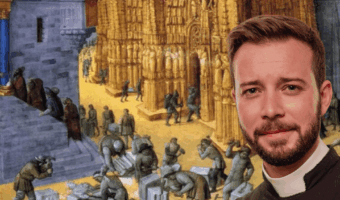
Bâtisseur de cathédrale biblique : l’abbé Thomas Duchesne

Bâtisseur de cathédrale biblique : l’abbé Thomas Duchesne

13 mai 2026

Au cœur de la construction de notre cathédrale biblique, il y a des artisans passionnés… Thomas Duchesne, prêtre du diocèse de Fréjus-Toulon, collaborateur principal de la BEST pour la musique et la liturgie depuis 2018, étudiant en master de sciences bibliques avec l’UCLouvain/Domuni, premier prix du Conservatoire de musique du Nord (Luxembourg) en piano, orgue […]
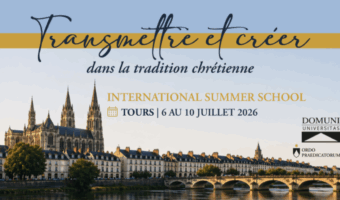
Transmettre et créer dans la tradition chrétienne – SUMMER SCHOOL – Du 6 au 10 juillet 2026

Transmettre et créer dans la tradition chrétienne – SUMMER SCHOOL – Du 6 au 10 juillet 2026

12 mai 2026

« Les inscriptions sont ouvertes pour la Summer School de Domuni Universitas, qui se déroulera du 6 au 10 juillet à Tours.Cet événement international propose des sessions traduites en trois langues et alterne enseignements le matin et expériences de terrain l’après-midi, pour allier réflexion, découverte et échanges interculturels.L’édition 2026, consacrée à la transmission, offre deux parcours complémentaires pour étudiants et enseignants, favorisant le dialogue entre recherche et pédagogie. » Notre directeur, le frère Olivier-Thomas, y donnera une conférence […]
Soutien et pétition d’universitaires israéliens après l’agression de notre collègue

Soutien et pétition d’universitaires israéliens après l’agression de notre collègue

1 mai 2026

Les professeures Karma Ben-Johanan et Ayelet Even-Ezra sont venues manifester leur soutien à notre sœur et collègue chercheuse — agressée mardi dernier dans la Vieille Ville.Elles ont apporté des fleurs et une lettre signée par plus de 300 professeurs —représentants tout l’establishment académique (les sept universités israéliennes, différents instituts etc.). Nous leur disons notre reconnaissance […]
Le père Lagrange et « La Bible en ses Traditions »

Le père Lagrange et « La Bible en ses Traditions »

22 avril 2026

Le périodique « Il est vivant » publie un article du frère Olivier-Thomas Venard sur la BesT. Il montre la continuité de l’histoire de l’École biblique et archéologique française de Jérusalem, de sa fondation par le frère Lagrange jusqu’au programme de recherches, La Bible en ses Traditions —qui prolonge son œuvre. Il met ainsi en évidence […]
La BesT est sur Wikipédia !

La BesT est sur Wikipédia !

19 mars 2026

Un article présentant notre projet a été publié sur l’encyclopédie en ligne. Il propose une présentation synthétique de notre projet éditorial et scientifique. Comme tout article publié sur Wikipédia, ce contenu évoluera en fonction des contributions et des discussions de chacun. Vous êtes tous invités à consulter l’article et à participer à son enrichissement : […]
Nouvelles passerelles entre BiblIndex et la Bible en ses traditions

Nouvelles passerelles entre BiblIndex et la Bible en ses traditions

9 février 2026

Le projet BiblIndex est un index des citations et allusions bibliques dans la littérature patristique de l’Antiquité et du Moyen Âge. Il s’inscrit de longue date dans un travail commun avec la Bible en ses traditions, appelé à s’amplifier. Une nouvelle étape de cette collaboration est désormais visible pour les utilisateurs : un bouton intégré […]
Collègues et collaborateurs

Collègues et collaborateurs

31 décembre 2020

À l’Académie des Inscriptions et Belles Lettres Le 6 mars dernier, une délégation de l’École biblique de Jérusalem était reçue à l’Institut de France par l’Académie des Inscriptions et Belles-Lettres (AIBL) dans le cadre de la célébration du centenaire de la reconnaissance de l’École comme École archéologique française. Rendre compte et transmettre « Le goût […]
At the CBA Summer Session in Santa Clara CA

At the CBA Summer Session in Santa Clara CA

14 septembre 2016

Our Continuing Seminar As every other year, we held a continuing seminar during the CBA Session at the begining of August. Fr. Kevin Stephens and fr. O.T. Venard led the sessions, and the programme included prof. Martin Albl, who has nearly finished James, and prof. Marc Girard, who presented thrilling points in the reception history […]